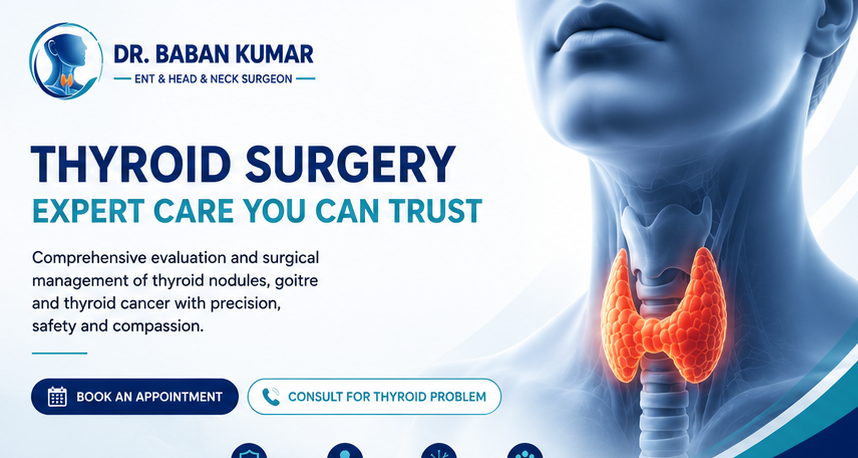

Thyroid Surgery
Expert Care for Your Thyroid Health
Why Choose Dr. Baban Kumar for Thyroid Surgery?
What sets us apart
Head & Neck Expertise
Specialized surgical care for thyroid and head & neck conditions
Accurate Diagnosis
Thorough evaluation of thyroid nodules, goitre and suspicious swellings.
Safety-Focused Surgery
Careful attention to important nerves and parathyroid glands during surgery.
Personalized Care
Treatment plans tailored to your diagnosis and individual needs.
Thyroid Cancer Care
Comprehensive surgical management of thyroid cancer and selected neck lymph nodes.
Dedicated Follow-Up
Ongoing postoperative guidance and support throughout recovery.
Frequently Asked Questions
Thyroid surgery involves removing part or all of the thyroid gland. It may be recommended for certain thyroid nodules, goitre, compressive symptoms, or thyroid cancer.
No. Many thyroid nodules are benign and can be monitored. Surgery is considered when clinical findings, ultrasound, FNAC or other investigations indicate an appropriate need.
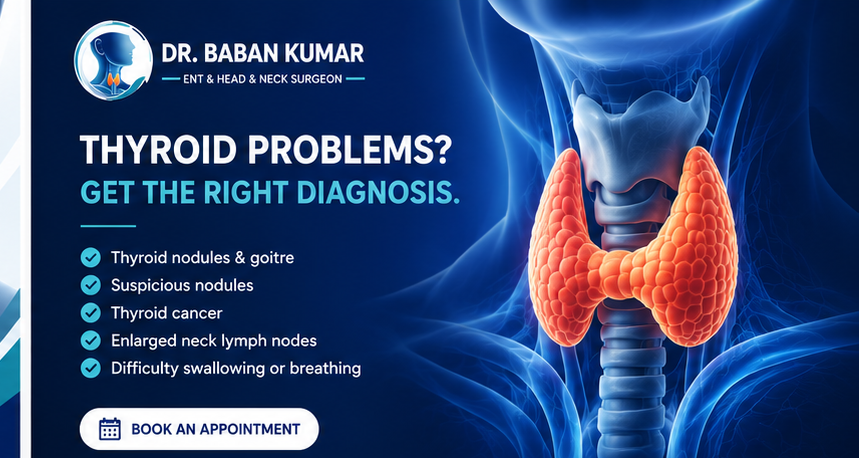
You should seek evaluation if you have a persistent or enlarging neck swelling, thyroid nodule, difficulty swallowing, breathing difficulty, persistent voice change, or an abnormal thyroid ultrasound or FNAC report.
Depending on your condition, evaluation may include thyroid function tests, ultrasound of the neck, FNAC and other investigations when required.
Depending on the diagnosis, surgery may include thyroid lobectomy (hemithyroidectomy), total thyroidectomy, and, for selected thyroid cancers, neck dissection.
Voice changes can occur after thyroid surgery because important nerves controlling the vocal cords are located close to the thyroid. Careful identification and preservation of these nerves is an important part of surgery.
After total thyroidectomy, lifelong thyroid hormone replacement is generally required. After removal of one thyroid lobe, some patients may have adequate thyroid function without lifelong medication.
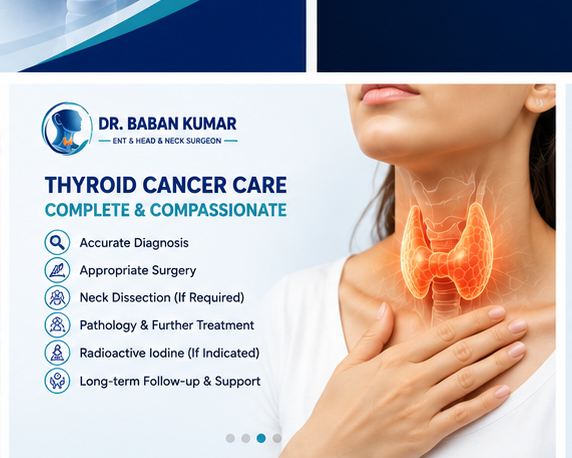
When indicated, thyroid surgery may be combined with removal of affected cervical lymph nodes. The exact treatment depends on the type and extent of thyroid cancer.
Recovery varies depending on the type of surgery and individual health. Your surgeon will advise when you can resume normal activities.
Thyroid surgery is generally safe when appropriately indicated, but like any operation, it has potential risks. These can include bleeding, infection, voice changes and changes in calcium levels. Your surgeon will discuss the benefits and risks before surgery.
Yes. A large thyroid swelling can sometimes compress nearby structures and cause difficulty swallowing, breathing discomfort or a feeling of pressure in the neck.
The thyroid is located close to important nerves, parathyroid glands, blood vessels, the airway and lymph nodes. A Head & Neck Surgeon has specialized training in the surgical anatomy and management of this region.
Still have questions?
Get in touch